Be the answer, in AI search and on your own site.
Customers ask AI before they ask you. HelpGuides gets your docs cited in ChatGPT and Google, answers visitors on your own site with HelpGuides Messenger, an AI agent that brings in your team when a person is needed, and shows you every question your docs can't answer yet.
30-day free trial · no credit card · from $19/seat/mo
Structured for the answer engines and AI assistants your customers already use.





Answered everywhere your customers ask
Your customers ask questions in AI search, on your website, and through your team's AI tools. HelpGuides answers all three from the same knowledge.
Cited by answer engines
Clean, schema-rich articles that answer engines can read, trust and cite, so your answer is the one people see.
The complete guide to getting found by AI →Answered by your AI agent
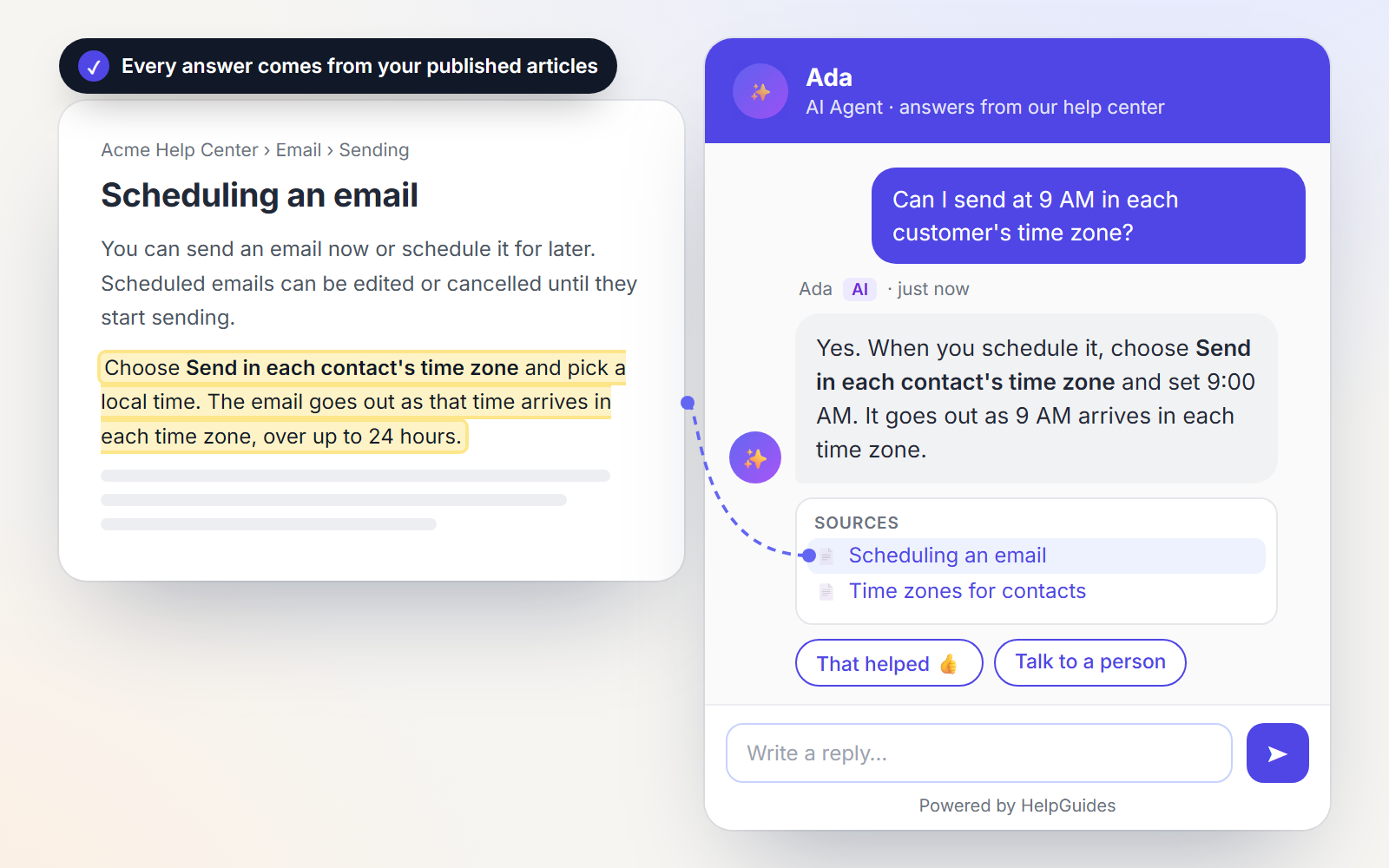
An AI chat agent answers visitors in seconds from your published articles, and hands off to your team the moment a person is needed.
HelpGuides Messenger →Connected to their tools
Built-in Model Context Protocol (MCP) support connects your docs to Claude, ChatGPT, Copilot and your own agents, with no scraping and no copies to keep in sync.
An AI agent that answers from your docs, and only your docs.
Add one snippet to any website. The agent answers first and links the articles it used. When your docs don't cover a question, it says so and brings in your team instead of guessing.
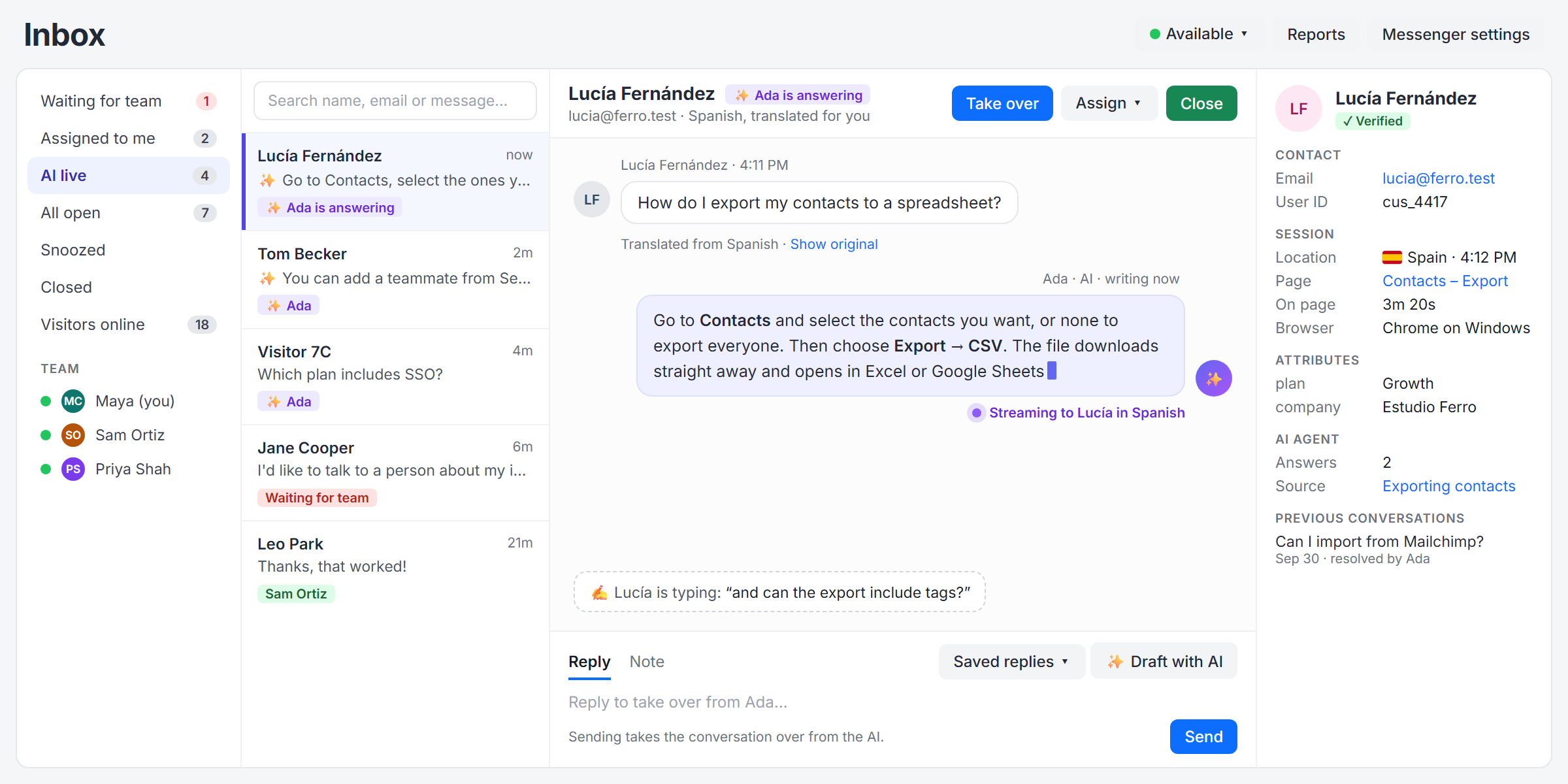
A shared inbox for your whole team
Watch every conversation as it happens and take over mid-answer.
Handoffs with context
Pick up with an AI-written summary. Outside support hours, the AI says when you're back and your team follows up by email.
Proactive
Greet visitors on pricing and demo pages, and start a chat with anyone on your site.
Connected
Route questions to the right team in Slack, and let the AI look up live data from your own APIs.
Every unanswered question makes your content better
A help desk bot can only answer from what it's given. Because HelpGuides owns your knowledge and the conversation, it shows you exactly what's missing, and every fix improves both your chat answers and your AI search visibility.
In their own words
Visitors ask the AI agent in their own words. Most get an instant, sourced answer.
In one report
Questions the AI couldn't answer from your docs are collected in one report, in your customers' own words.
Chat and AI search
Publish the missing article and the AI agent answers it next time, while answer engines have something new to cite.
Everything your documentation needs
Help centers, API references and internal SOPs, written once and ready for people and AI alike.
Write and publish
A block editor or Markdown, with drafts, working copies, and version history you can roll back. Import from WordPress, HubSpot, Freshdesk and HelpDocs.io.
Search that answers
Readers press Ctrl+K to search, or ask a question in their own words and get an answer streamed from your docs. Knowledge bases and AEO →
Output built for AI
Every article is lean, semantic HTML, plus Markdown and chunked JSON for RAG pipelines, and your llms.txt is generated for you. How to structure docs for AI →
Found in search
Schema markup, clean metadata and fast pages on your own domain and brand, so search engines and answer engines both find you. AEO vs. SEO →
Analytics that point to the fix
See what readers search for, which articles resolve issues, and how often the AI answers without a person. Review reminders flag articles going stale.
For every kind of knowledge
Run a branded customer help center, developer docs, and private internal knowledge from one account. What is knowledge base software? →

Your documentation, connected to Claude
Connect HelpGuides to Claude Desktop, Claude.ai or Claude Code in minutes, with no custom integration or scraping. Claude searches and reads your docs live, so answers come from your current content.
- The connection works both ways: draft articles, update them, add images and publish, all from a conversation with Claude
- Each of your help centers is its own connection, so Claude always knows which one it's working in
How MCP is changing how content gets made →
Built for answers, not just pages
Most documentation tools were built for pages. Here's the difference.
| CAPABILITY | HELPGUIDES | LEGACY DOCS TOOLS |
|---|---|---|
| AI-ready output | ✔ Semantic HTML, Markdown and JSON for every article | ✖ Presentation-heavy HTML, with exports needing custom pipelines |
| Model Context Protocol (MCP) | ✔ Built in, for reading and writing | ✖ Rarely supported or requires manual implementation |
| Search APIs for AI & applications | ✔ Public and programmatic search access | ✖ Often unavailable, restricted, or not API-friendly |
| AI chat agent on your website | ✔ Built in: answers only from your docs, with sources and human handoff | ✖ Requires a separate help desk and a knowledge sync |
| Unanswered questions → content gaps | ✔ See what customers asked that your docs don't cover | ✖ Chat and documentation live in different tools |
| Analytics & content freshness | ✔ Built-in reports and review reminders | ✖ Requires add-ons, manual audits, or external tools |
Not sure what AEO-ready actually means? Use the AEO Content Checklist →
Teams use HelpGuides to ship better docs, faster
From lean SaaS startups to growing product teams, HelpGuides helps keep documentation organized, searchable, and AI-ready.
“We went from scattered docs and Confluence chaos to a single, fast, AI-ready knowledge base in days, not weeks.”HEAD OF PRODUCT, B2B SAAS
“Our support team now deflects more tickets automatically because our docs are structured for both customers and our AI assistant.”DIRECTOR OF CUSTOMER SUPPORT
“As a developer, I care about clean data. HelpGuides gives us Markdown, JSON, and APIs that just make sense.”ENGINEERING LEAD
Pricing
Pay per editor seat for your docs, and only when the AI chat agent actually resolves a customer's question. Readers and chat users are always free.
Starter
- Hosted docs
- Markdown and visual editor
- Standard search
- Basic analytics
- AI chat agent
Growth
- Everything in Starter
- Custom domains
- Version history
- MCP server integration
- Team collaboration
Enterprise
- Everything in Growth
- SSO / SAML
- Audit logs
- Auto-translations
- Custom CSS
- Priority SLA
AI chat that only charges when it works
Every plan includes an AI chat agent that answers your customers from your HelpGuides docs. Beyond your plan's monthly allowance:
or prepay 1,000 resolutions for $150 ($0.15 each) · 80% less than Intercom Fin's $0.99
- A resolution is a chat where the AI answered from your documentation and the customer confirmed it answered their question, or left without needing more.
- Never charged: chats handed to your team, "Not helpful" answers, poor ratings, contact requests, and questions your docs couldn't answer.
- No seat tax on support or readers. Reading your docs and chatting with the AI is free and unlimited for your customers. You pay only for the team members who write and manage content.
| 5 seats × $49 | $245 |
| 1,000 resolutions included | $0 |
| 1,500 more × $0.20 | $300 |
| Per month | $545 |
Frequently asked questions
What is HelpGuides?
HelpGuides is a documentation platform built for modern Answer Engine Optimization (AEO). Create user guides, API docs, knowledge base articles, internal processes, and more, all as clean, structured content optimized for both humans and large language models. Then answer customers from it with a built-in AI chat agent. Learn more about AEO →
Does HelpGuides include AI chat?
Yes. Add one snippet to any website and an AI agent answers visitors using only your published HelpGuides articles, with links to its sources. When a question isn't covered, it hands the conversation to your team in a shared inbox, where anyone can watch the AI live and take over. See HelpGuides Messenger →
How is HelpGuides chat different from a help desk bot?
Help desk bots answer from content you sync in from somewhere else. HelpGuides owns both your knowledge and the conversation, so it shows you exactly which questions your docs don't answer. Every article you add improves your chat answers and your visibility in AI search at the same time.
How does AI chat pricing work?
Every plan includes a monthly allowance of AI resolutions: 100 on Starter, 1,000 on Growth and 5,000 on Enterprise. After that, each resolved chat is $0.20, or $0.15 when you prepay 1,000 for $150. You're only charged when the AI resolves the question from your docs. Chats handed to your team, marked not helpful or rated poorly are free.
Do you offer a free trial?
Yes. You can try HelpGuides free for 30 days with no credit card required. Upgrade whenever you're ready.
Can I use HelpGuides for my product documentation?
Absolutely. HelpGuides was built specifically for teams who need modern, AI-friendly documentation that's easy to maintain, scale, and integrate into support or development workflows.
Does HelpGuides support Markdown?
Yes. Every article can be accessed as a Markdown URL, making it ideal for developers, integrations, and platforms that prefer Markdown over HTML.
Does HelpGuides support versioning?
Yes. Each time an article is updated, the previous version is automatically stored so you can review, compare, or revert at any time.
Does HelpGuides support working copies?
Yes. Edit published articles as working copies and promote changes when you're ready, which is perfect for collaborative editing and content reviews.
Does HelpGuides support llms.txt?
Yes. HelpGuides can automatically generate your llms.txt file based on the content you designate as most important for AI crawlers and assistants. Learn more about GEO and llms.txt →
Is HelpGuides a CMS?
HelpGuides is not a traditional CMS. While CMS platforms are designed for marketing sites, HelpGuides is focused exclusively on structured knowledge and documentation optimized for search engines and AI systems. See why knowledge bases are the most overlooked AEO asset →
Is there a developer API?
Yes. HelpGuides includes both public and secure APIs for managing articles, categories, search, integrations, and more, ideal for developers building custom workflows or AI-driven applications.
I have a problem with my account. How can I get help?
If you need assistance, just click the Contact Us link in the footer or reach out directly. We're here to help.
Ready to be the answer?
Structured knowledge for AI search, an AI agent that answers on your site, and a clear view of what to write next.